Possible Once, Not Routinely
Use a manual lift only as a short-term way to get a vehicle out. Repeated cycles without spring assistance increase wear on rollers, hinges, and track alignment.
Phoenix Garage Door Repair Co. explains why a broken spring turns a residential garage door into 130 to 400 pounds of unsupported weight. A one-time manual lift may free a vehicle, but the missing counterbalance makes the door hard to control and able to fall unexpectedly.
Use a manual lift only as a short-term way to get a vehicle out. Repeated cycles without spring assistance increase wear on rollers, hinges, and track alignment.
Once the spring separates, the tracks, rollers, cables, and anyone lifting the door must carry its dead weight. A slipping hand or shifting cable can let the door slam down.
Pull the red release cord to separate the trolley from the opener carriage before a manual lift. Do not press the wall control or remote while the spring is broken.
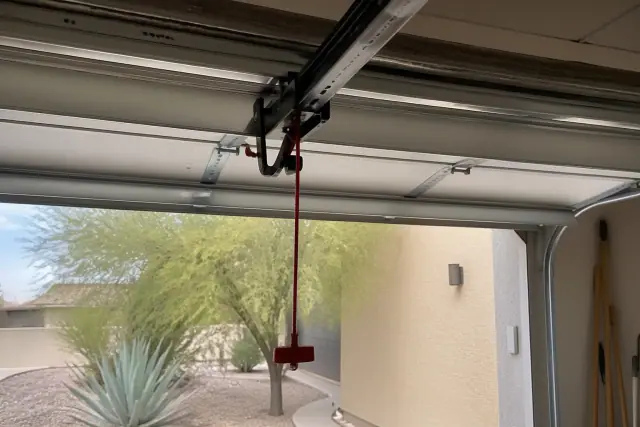
The red cord hangs from the opener trolley, which separates from the carriage when released. Identifying this hardware helps you disconnect the opener without approaching the spring or cables.
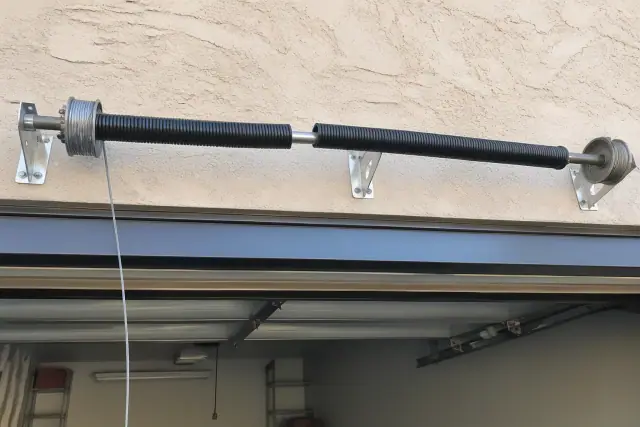
A separated coil above the door or a slack cable beside the track signals an unstable counterbalance system. Either condition means the door may carry an uneven load and should not be lifted.
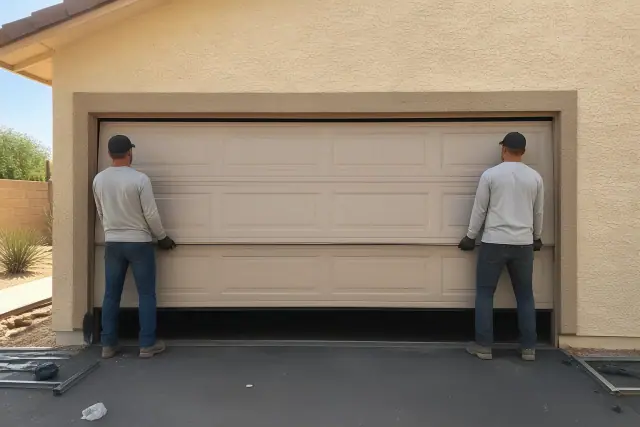
A two-person lift places one adult at each side so the bottom edge rises evenly. Both people must keep their hands clear of panel joints and stop if the door tilts or binds.
Look for a separated torsion coil above the door or a parted extension spring beside the horizontal track. Do not touch a severed spring or tensioned cable.
A lighter single-car steel door may move by hand, while a double-wide insulated or wood-composite door can push 300 to 400 pounds and become close to unliftable safely by one person.
An electric opener can burn out its motor within minutes when forced to lift a door without spring assistance. Continued operation can also strip the drive gear or strain the capacitor.
Torsion springs require calibrated winding bars and a torque setting matched to door weight and track drum size. Replacement also requires matching wire gauge, coil diameter, and spring length.
| Door condition | What it means | Safer action |
|---|---|---|
| Closed, level door with a confirmed broken spring | A single manual lift may be physically possible, but the spring no longer counterbalances the door. | Disconnect the opener, use one adult on each side, and stop if the door binds or tilts. |
| Double-wide insulated or wood-composite door | At 300 to 400 pounds, the unsupported door can be close to unliftable safely by one person. | Keep it closed and arrange spring repair. |
| Crooked door, loose cable, or roller off track | The load may be uneven and the door can fall or leave the tracks. | Do not lift it; clear the area and request a professional inspection. |
Garage door springs normally store and release energy as the door travels, counterbalancing most of its weight. When a torsion spring snaps or an extension coil separates, that assistance disappears, so the door becomes dead weight on the tracks, rollers, and cables. A manual lift does not restore balance; it only moves the unsupported door temporarily.
Torsion springs mounted above the door are standard on many Phoenix homes built after the 1980s, while extension springs along the tracks remain common in older Encanto and Coronado garages. Repeated expansion and contraction between summer highs over 110°F and winter mornings near freezing in higher elevations north of the valley can accelerate metal fatigue. Most residential springs are rated for about 10,000 cycles-roughly 7 to 9 years at two cycles per day-while higher-cycle options may be rated for 20,000 to 25,000 cycles; Phoenix heat cycling can place typical failure around 7 to 10 years.
Can you use the opener? No-leave it disconnected until the spring is repaired. Can you leave the door open? Only with a sturdy support, because no spring tension is holding it in place. What does spring repair cost in the Phoenix metro? Published data places a single spring at $300 to $750 and a matched two-spring set at $500 to $1,500, depending on door size, cycle rating, and whether cables or drums also need replacement.
If a broken spring has trapped a vehicle or left the door unsecured, keep people clear of the opening and request an inspection. Same-day and 24-hour repair is available across the Phoenix metro for safety-critical spring failures, with checks of the cables, rollers, track alignment, drums, and opener before the system returns to service.